Showing posts with label technology. Show all posts

Sunday, February 19, 2012

Upgraded Aakash tablet to be available at same price: Kapil Sibal

Aakash, the world's cheapest tablet, will be fully indigenous soon and its improved version will be launched by the government at the same price.

Telecom and HRD Minister Kapil Sibal said Datawind - the manufacturer of the product -will not be associated with it anymore and the Government has roped in C-DAC and ITI in further development of the tablet computer.

"There have been some problem with Datawind I must confess. Therefore, I have got into the act. IT Ministry has got C-DAC and ITI into the act and I am going to ensure that this product is fully indigenous and truly an Indian product," he said.
On whether the new tablet will be available within the same price range as that of the earlier product, he said, "Yes that's what we hope. It is to be upgraded."

On the possible timeline for launching it, he said, "Well, 2012 should seen the sun... Aakash-II should be launched. There have been some hiccups in the way. Remember when you do a project of this nature and when your dream is as big as this, things are never that smooth."

Welcoming competition from market for development of the tablet, he said the ultimate objective is to give a quality product to the children. "I think its a great thing if there is competition. Ultimately my objective is to get a quality product in the hands of the children. I have set the benchmark, it has changed the mindset of the world, I can tell you that," the Minister said.

Everybody now wants to produce a tablet which is of quality and which is reasonably affordable, he noted.

"So if the whole world wants to produce, I don't care who produces, if ultimately it is produced by somebody for children," he underlined.
The Aakash tablet is priced at
approximately USD 49 (Rs 2,414).

Tuesday, November 15, 2011

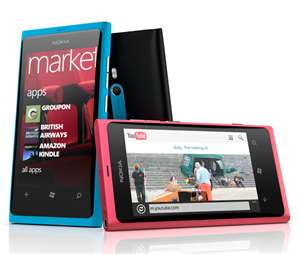
Nokia Lumia 800, first Windows Phone running Mango

Nokia has come up with its first Windows Phone in India, the Lumia 800, which runs the latest Windows Phone 7.5 aka Mango. nokia lumia 800

The mobile phone has been priced for Rs 29,000 and will hit the stores in the country next month.
The long awaited Nokia Lumia handset both appears as well as feels great, as it was expected. Well it can be said it was worth waiting for so long for the device.

Lumia 800 equips a clear black 3.7-inch impressive touchscreen display, supporting 480 x 800 pixels
resolution. The mobile phone offers an interesting feature that is, its 252 ppi pixel density, due to which is offers a crisp view.

It comes designed with a 12.1 mm thick body and weighs 142 grams which is not light. However the last month launched Samsung Omnia is lighter in weight and has a sleek design in comparison to it. The new Nokia Lumia 800 comes in three different colour options that are cyan, black and fascia, due to which you'll find the device looking fresh and attractive.

The gizmo packs a powerful 1.4 GHz application processor to run Windows Phone Mango 7.5. Besides, it also embeds a 512 MB of RAM to allows faster and better performance. The latest creation of the brand offers native Windows user interface comprising fantastic live tiles, and works amazingly.

Nokia Lumia 800 equips an 8- megapixel main camera and Carl Zeiss optics lens for clear images.
Moreover, the device also comes along with a dual LED flash that allows clear videos and pictures even when there is inappropriate lighting.

The device is capable of recording 720p HD videos. The latest Nokia smartphone has an on-board memory of up to 16 GB. It has been created emphasizing on its looks and designed quite like the Nokia N9, which has not released in many of the markets.

Overall the Nokia Lumia 800 is an excellent device, however it seems a bit over priced, especially when users have  cheaper option Samsung's first Windows Phone Omnia W.

Monday, November 14, 2011

Nokia launched first windows based smartphone

Global handset maker Nokia,along with Microsoft, on Monday announced the launch of its first smartphone based on the Windows operating system in the Indian market.

The move is expected to boost Nokia’s presence in the smartphone market, which has seen the company lose market share steadily.
nokia lumia 800 windows based smartphone
Lumia 800
nokia lumia 710 windows based smartphone
Lumia 710
The phones — Lumia 800 and Lumia 710 — have been priced at about $580 and $380 globally, respectively, and would be available in the retail market from mid-December.

Nokia would do away with the Symbian platform in the coming years, and replace it with the Windows operating system in all its smartphones, said Nokia India Managing Director, D Shivakumar. “The success of any phone in India is decided within three-four weeks of its launch, and we are confident that this is a winner, since we have already trained about 12,500 distributors, retailers and priority dealers who can sell Nokia Windows phone to smartphone buyers,” Shivakumar said.

The smartphone market, expected to account for 20 percent of the total handset market in value terms, has become a hotbed for handset vendors. Nokia unveiled its smartphone nearly a week
ahead of Apple, which is rumoured to launch the iPhone 4S in India on November 24.

The Finnish handset company expects the smartphone market in India to grow at a compounded annual growth rate of 50 per cent in 2010-15, owing to 3G services and increased data usage. Globally, Nokia fell to No. 3 slot in the smartphone market, behind Samsung and Apple, according to market researcher Strategy Analytics. The company, however, continues to account for almost 30 per cent of market share in India.

For Microsoft, the smartphone platform presents a huge opportunity to tap theconsumer market. With a large presence in the government and education sectors in India, Microsoft is confident that the Windows phone would become the second-most popular smartphone operating system by 2015.

While rivals Samsung and HTC already have smartphones on the Windows platform, Bhaskar Pramanik, chairman, Microsoft India, said, “What matters is the hardware and software integration. We have worked closely with Nokia to offer a unique user experience to users of the Lumia range of devices.”

Microsoft Windows operating system is expected to grow at 123 per cent until 2015 in the global market. Currently, in India, the operating system has less than one per cent market share, according to StatCounter data.

“It is more important for Nokia to provide consumers a strong experience in targeted markets and listen to consumer feedback to improve and further differentiate future Windows smartphone releases, than it is to quickly ramp volume of its initial Windows launch,” say analysts at
Canaccord.

The new Lumia range has the internet explorer 9 browser and in-built social networking sites like Facebook, LinkedIn and Twitter embedded into the operating system. The range also boasts of applications such as Nokia Maps and Drive, which would have personal navigation devices in 50
languages, including Hindi. The company would offer maps of 100 countries and 750 cities across India free on all Nokia Lumia devices. Nokia Music and the MixRadio, a free global mobile music streaming application, would also be available. These services would be made available in India in
the first half of 2012.

Nokia would also provide 750 local applications by nearly 1,000 Indian developers on the Lumia device. The device has already been launched in Europe.

Thursday, October 20, 2011

Secret desk drawer that opens with a magnetic handle

dish washer
Secret desk drawer that opens with a magnetic handle

This project is about concealing valuables, secrets, bad habits and personal information in our workplaces. Here, hidden spaces/ messages were created within 8 general objects such as wood boards, lamps and disposable coffee cups.

Why doing this?
We all have the need of hiding.

We hide our valuables from being stolen, we conceal our past from our loved ones, we never show our real side to colleagues, we all have secrets. Or, sometimes we just want to keep something only for ourselves.

How?
Utilize stereotypes and visual camouflage.

We make judgments based mainly on our experiences and what we see. This dependency on visual information can create large blind spots. Thus, usual stereotypes of how we perceive solid, transparency and lighting are employed in this project to play with notions of ‘solid and void’, and ‘true and false’.

Sunday, October 9, 2011

AAKASH - World Cheapest Tablet

AAKASH - worlds cheapest tab at rs1100
AAKASH - World Cheapest Tablet (updated)
PRICE@1700 rupees, 1100 for students. (update: Rs 2999)
Available in November. To book it online see How to Book Aakash Tablet Online
Features of World Cheapest Tablet Launched by Indian Government: The tablet runs on Android 2.2 (Froyo) and comes with a 7-inch resistive touchscreen with 800x480 resolution and weighs 350 grams.

The tablet has a 256MB of RAM, a 32GB expandable memory slot and two USB ports.The tablet comes with a 12-month replacement warranty and supports formats like DOC, DOCX, PDF and PPTX etc. Aakash has a standard 3.5mm headphone jack...
World Cheapest Tablet:
The mighty $35 Indian Tablet is finally launched in India on October 5. Kapil Sibal, minister of communications and information technology confirmed.In Indian Rupee, the price of the tablet is Rs. 1700. The Indian Government will subsidize the cost of the tablet and offer it to students for about Rs. 1100.

Specifications:
  • 366 Mhz Processor and a dedicated HD video processor
  • Android 2.2 Froyo
  • 7 inch Resistive touch screen
  • Full HD video playback
  • 2100maH battery
  • 256 MB RAM
  • RAM : 256 MB
  • 2GB internal memory + 2GB Micro-SD (expandable up to 32 GB)
  • Wi Fi connectivity
  • 2 USB ports
  • Dimensions: 190.5 X 118.5 X 15.7 mm
  • Weight: 350 gms
The device will be sold as DataWind Ubislate for Rs 2999 inclusive of taxes and will be available from Nov.2011.
You can check the review of the tablet by NDTV.

Saturday, August 20, 2011

New Android tablet launches for $99

A small private company has announced the launch of a new Android-based tablet for India and it is priced at a mere $99. Well, the pricing does seem quite shocking, but the company, Lakshmi Access Communication Systems (LACS) are planning to bring in not just one, but a few low-cost versions of tablets, which they claim will rival Apple’s iPad 2 and Samsung’s Galaxy Tab 10.1.
New Android tablet launches for $99

The Magnum Pepper

The $99 base model tablet, named Magnum Pepper Tablet PC, works on Google’s Android 2.2 OS and comes with an 800 MHz processor and 256MB RAM. It has a 7-inch LCD sensitive touch display, but the display type hasn’t been divulged. Whether it’s capacitive or resistive might make a big impact in the tablet’s sales. We’re pinning our hopes on a capacitive touch screen. However, it’s more likely to be a resistive one. Furthermore, the base model will have Wi-Fi, RJ45 LAN port, USB 2.0, MicroSD card support up to 32GB, 3G compatible dongle, 3.5mm jack, G-sensors, front camera and built-in 2GB of memory. With all these features and at that price this tablet is definitely a steal!
Price Comparison Chart

Price Comparison Chart

We’ve drawn a comparison between four of the major tablets currently and you can gauge the price difference between the Magnum Pepper and the rest. The price is definitely impressive and may directly compete with the Reliance 3G tablet and Beetel Teletech’s Magiq tablet. However, it’s the specs and the performance that will eventually decide the fate of the tablet. But, it seems that local competition has increased and that is nothing but good news for consumers.

VAIO C Notebooks available in any colour you like

sony india launches vaio in any color u like <<Sony India launches its new colourful range of Sony Vaio Notebooks


Sony’s latest series of trendy notebooks, the VAIO C, comes in many colours including red, orange and black. The outer shell of the notebook is primarily made up of translucent plastic, making it look more like a kid’s toy than anything else.

 The lid has a bit of flex, but the screen is sturdy and doesn’t ripple when its edged are pinched. The chiclet-style keyboard is backlit and the best part with an ambient light sensor automatically turning it on or off according to the lighting conditions.

Horsepower
The notebook may look like a toy, but it packs in serious horsepower beneath those flashing lights. Intel’s Core i5-2410M takes centrestage, running at a speed of 2.3GHz with the ability to turbo up to 2.9GHz. There’s a single 4GB DDR3 memory stick, so you can add another one yourself later. For storage, you get a 500GB hard drive spinning at 7200rpm. The C series makes for a decent gaming laptop as well, with AMD’s HD 6630M and dynamic switchable graphics.

The 14-inch LED backlit screen sports a resolution of 1366x768, which is good enough for general and multimedia playback. The 1.3MP webcam also features Sony’s ‘Exmor’ video engine for a clearer picture. The Core i5 processor is a very capable performer for everyday tasks and copes well even under stress. Games run fairly well too.

Keyboard is great
At 2.45kg, you’ll definitely feel the VAIO’s weight in your backpack. That aside, the keyboard is a dream to use with great play. Even while charging, the notebook only gets a bit warm, which is impressive. Finally, the built-in speakers are loud and clear but lack bass.


Switchable graphics
This is one of the first notebooks we’ve come across which has a dynamically switching graphics card. The Catalyst software in the notebook has a new option called ‘Switchable Graphics’ that lets you configure which programmes use the dedicated graphics card and which ones use the onboard hardware. But this feature is not as polished as compared to Nvidia’s Optimus.

Average battery life
Under average usage, you should easily manage 2.5-3 hours with ‘Power Saver Mode’ on and brightness level set to medium.

What we like
Good choice of colours
Powerful Intel Core i5 processor.
Easy to install a new hard disk or memory

What we don’t
Average battery life of only 2.5-3 hours
Switchable graphics not as good as Nvidia’s Optimus

Verdict
At R 55,990 for the model we tested (VPCCA15FG), the VAIO C is a good buy given its features and performance. Funky looks apart, it has ample firepower under all the hippie lighting effects. Highlights include the auto-switchable graphics, auto-backlighting of the keyboard and a comfortable keyboard. It can also handle DX10 games pretty well without compromising too much on quality. Just watch out for so-so battery life and the weight.

Monday, August 1, 2011

Researchers Create Smallest Battery Ever Made

A team of scientists has created a battery so small that it fits into a "nanowire," a wire whose thickness is less than the wavelength of visible light. It's the smallest battery ever made, and it could end up powering a whole generation of nanotechnology.

The potential of nanotechnology—the practice of building machines so small that they can't even be seen—has been talked about for decades. In medicine, for example, the idea of creating tiny robots that could enter a person's bloodstream and target intruders or diseased cells has been touted as one of the most promising applications of the field, but it's remained purely theoretical.

One of the hurdles standing in the way of such wondrous nanodevices is their power supplies—making batteries at such a tiny scale is difficult. Now a team of engineers from Rice University appears to have solved that problem by creating a battery just 50 microns, or about the thickness of a human hair.

To create the battery (see the diagrom below), the researchers first coated a nanowire template with a thin layer of copper. They then filled the pores (which create the individual nanowires) halfway with a nickel/tin alloy to create the anodes. At this point, they put on a thin layer of polyethylene-oxide gel, which acts as both an electrolyte and an insulator from the other nanowires. Next they filled the remainder of the pore with a polyaniline material to create the cathodes. A layer of aluminium goes on top to complete the circuit.

Every nanowire is just 150 nanometers (nm) thin. To put that in perspective, the lowest wavelength of visible light is about 400 nm. However, the complete battery is about 50 microns tall, or about the width of human hair. The researchers ended up creating an array of nanowire batteries that was about 0.08 square inches in area, though it's theoretically scalable to even larger sizes.

With a larger array that includes several layers stacked on top of each other, the tech could theoretically lead to batteries with massive energy density. And since the electrochemical materials don't contain lithium, they're easy to synthesize and manipulate at room temperature.

The nanowire batteries aren't without their limitations, however. After being charged and discharged 20 times, they lose their ability to hold a full charge. The researchers are working on addressing this limitation, however, by playing with the polymer thickness and trying out different kinds of electrodes.

Although it's in the early stages, the new battery technology could help usher in an era of practical nanomachines. With a real microscopic power source, the science-fiction scenario of tiny machines acting as doctors, builders, and explorers just took a step toward reality.

Thursday, July 21, 2011

The Most Unforgettable Space Shuttle Pictures

When the space shuttle Atlantis lands on Thursday, it will wrap up STS-135, the final shuttle mission in the U.S. program's 30-year history.

Even with the tragic losses of Challenger and Columbia, the space shuttle has become an icon among U.S. science and technology achievements. During the past three decades, shuttles carried the first U.S. woman and the first African American into space, deployed famous satellites such as the Hubble Space Telescope, and delivered valuable parts and supplies to the International Space Station (ISS).

"The space shuttle has been with us at the heart and soul of the human spaceflight program for about 30 years, and it's a little sad to see it go away," STS-135 mission commander Christopher Ferguson recently told reporters in a televised interview from the ISS.

"It's going to be an emotional moment for a lot of people that dedicated their lives to the shuttle program for 30 years. But we're going to try to keep it upbeat ... We're going to try to make it a celebration of the tremendous crowning achievements that have occurred."

View Fullscreen Slideshow
The Most Unforgettable Space Shuttle Pictures
Sitting on a rolling platform, the space shuttle Challenger emerges from the mist at Kennedy Space Center in Florida as it heads toward the launch pad, just visible in the distance, in November 1982. Challenger lifted off on its maiden voyage in
April 1983 for the sixth shuttle mission.

The Most Unforgettable Space Shuttle Pictures
Astronaut Sally Ride floats in front of the control panels for the space shuttle Challenger on June 25, 1983, while serving as a mission specialist for STS-7. Ride became the first U.S. woman in space during this mission.

The Most Unforgettable Space Shuttle Pictures
Astronauts John M. Grunsfeld (right) and Richard M. Linnehan stand next to the Hubble Space Telescope, which was brought into the space shuttle Columbia's payload bay for repairs during STS-109, as seen on March 8, 2002.

The Most Unforgettable Space Shuttle Pictures
The space shuttle Endeavour—payload bay doors ajar —rushes past Earth while docked to the International Space Station on May 28, 2011.

The Most Unforgettable Space Shuttle Pictures
Suspended above the planet, the space shuttle Endeavour is silhouetted against the layers of Earth's atmosphere in a picture taken by an ISS crew member on February 9, 2010. The shot shows the shuttle shortly before it docked with the space station during STS-130.

The Most Unforgettable Space Shuttle Pictures
Seen outside the space shuttle Discovery during STS-51-A, astronaut Dale Gardner enjoys a moment of levity as he completes a spacewalk to recover two broken communications satellites from orbit on November 14, 1984. Astronaut Joseph P. Allen IV is seen reflected in Gardner's helmet visor.

The Most Unforgettable Space Shuttle Pictures
The space shuttle Columbia sits on a launch pad at Kennedy Space Center on March 5, 1981. Columbia launched on the first shuttle flight, STS-1, on April 12, 1981.  Following the first two launches, NASA calculated that they could safely shave 600 pounds (272 kilograms) from a shuttle's overall launch weight by not painting the large external fuel tank white and instead leaving its orange insulating foam exposed.

The Most Unforgettable Space Shuttle Pictures
A softly glowing plume is all that remains visible of the space shuttle Endeavour after a nighttime launch from Florida's Kennedy Space Center on March 11, 2008.

The Most Unforgettable Space Shuttle Pictures
Originally slated to bear the name Constitution, the first space shuttle to be built was dubbed Enterprise following a write-in campaign from Star Trek fans. Above, cast members from the science- fiction show attend the shuttle's rollout ceremony in Palmdale, California, on September 17, 1976. From left to right: Leonard Nimoy, who portrayed Vulcan science officer Spock; George Takei, who was helmsman Hikaru Sulu; DeForest Kelly, who was chief medical officer Leonard "Bones" McCoy; and James Doohan, who was chief engineer Montgomery "Scotty" Scott.

The Most Unforgettable Space Shuttle Pictures
Spectators gather in the late-morning heat to watch the space shuttle Atlantis lift off for STS-135, the final shuttle mission, on July 8, 2011.

The Most Unforgettable Space Shuttle Pictures
A cloud of debris spreads in the sky over coastal Florida as the space shuttle Challenger breaks apart on January 28, 1986. The orbiter disintegrated 74 seconds after launch during STS- 61-C, killing all seven crew members.

The Most Unforgettable Space Shuttle Pictures
Earth seems ready for loading into the space shuttle Endeavour's open payload bay in a picture taken in December 1998 using an onboard IMAX camera. The large-format camera was sent into space during STS-88 in part to film the installation of the Unity Node, the first U.S. module for the International Space Station.

The Most Unforgettable Space Shuttle Pictures
Technicians work on a test firing of a space shuttle main engine at the National Space Technology Laboratories in Bay St. Louis, Mississippi, before the first flight of Columbia in 1981.

The Most Unforgettable Space Shuttle Pictures
The crew of STS-102 works on the flight deck of the space shuttle Discovery to dock the shuttle with the International Space Station on March 10, 2001.

The Most Unforgettable Space Shuttle Pictures
A technician inspects one of the nylon parachutes used to slow the descent of a space shuttle's solid rocket boosters before STS-1 in 1981. The 80-ton rockets detached shortly after launch and splashed down in the Atlantic Ocean, where they were recovered for reuse.

The Most Unforgettable Space Shuttle Pictures
Riding piggyback on a Boeing 747, the test shuttle Enterprise glides over the New York City skyline in June 1983. Unable to fly like airplanes under their own power, shuttle orbiters had to be transported long distances atop of other aircraft.

The Most Unforgettable Space Shuttle Pictures
A tornado forms a dark column near the launch pad, where the space shuttle Columbia waits to launch on STS-93, as seen on July 20, 1999. The shuttle lifted off July 23, carrying NASA's Chandra X-ray Observatory into orbit.

The Most Unforgettable Space Shuttle Pictures
Staff at the Mission Control Center of Johnson Space Center in Houston, Texas, monitor the landing of the space shuttle Columbia on April 14, 1981, after the first ever shuttle mission to reach orbit.

The Most Unforgettable Space Shuttle Pictures
Curling like bizarre sigils in the sky, plume remnants from the June 8, 2007, launch of the space shuttle Atlantis glow with the light of the setting sun. The so-called night-shining clouds created by the launch are seen over the Vehicle Assembly Building, or VAB.

The Most Unforgettable Space Shuttle Pictures
Seen from the space shuttle's payload bay, astronaut Mark Lee goes for an untethered spacewalk outside Discovery in September 1994

The Most Unforgettable Space Shuttle Pictures
A huge crowd—many driving recreational vehicles— gathers to watch the space shuttle Columbia land on July 4, 1982, at Edwards Air Force Base in California at the end of STS-4.

The Most Unforgettable Space Shuttle Pictures
A charred astronaut helmet lying in the grass near Norwood, Texas, was among the debris found after the space shuttle Columbia broke apart during reentry on February 1, 2003. The orbiter had completed STS-107 and was returning for landing, but damaged heat shielding caused the craft to disintegrate, killing all seven crew members.

The Most Unforgettable Space Shuttle Pictures
In preparation for STS-135, the space shuttle Atlantis is lifted high inside the Vehicle Assembly Building on May 18, 2011, so it can be attached to the "stack"—the combination of the large external fuel tank and twin solid rocket boosters.

The Most Unforgettable Space Shuttle Pictures
The gentle green glow of the aurora australis—or southern lights—curls over Earth in a picture taken by an astronaut aboard the space shuttle Discovery on August 6, 2005.

The Most Unforgettable Space Shuttle Pictures
Like a delicate water ballet, astronauts practice for a shuttle mission on December 10, 1997, in the Sonny Carter Training Facility—a giant swimming pool filled with life-size replicas of space hardware—at the Johnson Space Center in Houston, Texas.

The Most Unforgettable Space Shuttle Pictures
Cocoa Beach surfers watch from the water as the space shuttle Atlantis lifts off from nearby Kennedy Space Center in Florida on September 8, 2000.

Wednesday, July 20, 2011

Apple's new Mac mini ditches the optical-drive

apple Mac mini Mac OS X and the MacBook Air weren't the only Apple products to receive updates on Wednesday -- Apple's Mac mini gained a few new features and lost an optical drive too.

Like the MacBook Air laptop, Apple has worked Intel's Core i5 and i7 processors into the Mac mini, as well as beefier graphics chips, which the Cupertino company says adds up to performance that is twice as fast as the outgoing models.

The little desktop, a prime example of the tech giant's minimal design ethos (it's just an aluminum block after all), also gains a new high-speed Thunderbolt port to sit alongside the carry-over of four USB ports and one HDMI port (yes, it can be hooked up to a TV).

The new Mac mini ships with Mac OS X Lion, Apple's desktop and laptop operating system, and falls in price about $100 to start at $599, though with more memory and other options the price can hit a high of $1,849.
Like the previous generation Mac mini, which had a "super drive" CD/DVD player and burner built-in, the refreshed Mac mini has a one-piece aluminum body and is just 1.4-inches tall with a 7.7-inch square shape.

"Mac mini is designed without an optical disc drive. Because these days, you don't need one," Apple says on its website. "It's easier than ever to download music and movies from the iTunes Store. And you can download apps from the Mac App Store with a click."

However, for those not quite ready for Apple's disc-free future (there may be a couple of you out there), there are some workarounds if a DVD is needed to install software, or a CD needs to be ripped to iTunes. Mac OS X Lion enables the Mac mini to access the optical drives on other PCs and Macs wirelessly for such tasks and it also can work with an external USB optical drive.  

And, as always, the Mac mini comes without a keyboard or mouse.

Apple bids farewell to the MacBook

apple-macbook-airEveryone knew Apple was introducing something today, but what no one knew was that it was going to be saying goodbye as well.

In addition to Apple officially making OS X 10.7 available for download, it unleashed a fresh set of MacBook Airs, updating both the 11.6-inch and 13.3-inch model. Now they include a Thunderbolt port, Intel Core i5 or Core i7 chips, backlit keyboard, and faster 1333 MHz memory in up to 4GB. And slapping a $999 price tag on there makes for a very attractive, and yes, very thin package.

The knock on the Air before today was that it had outdated chips. Now you can’t say that, and there’s no longer any good reason to buy the old entry-level MacBook (that white plastic one), which also started at $999. Apple clearly agrees: If you head over to the company Web site to shop around for a laptop, the MacBook is nowhere to be found. The lineup goes right from Air to MacBook Pro. (The exception is if you’re in the education field. Apple will make the basic MacBook available to that group only.)

When the Air was first introduced in 2008, many considered its niftiest feature to be its capability of fitting inside an inter-office mail envelope. In other words, it was seen mostly as a pretty feat of engineering, but impractical for most people — no optical drive? How would that ever work?

Flash forward to the present, and this is the laptop Apple is going to be pushing most new buyers toward. The big hint about that is the fact that they’ve decided to use the new Air as the first laptops to come standard with Lion. The  Air, once a novelty, is now the standard Apple laptop.

Saturday, July 16, 2011

Google, Intel, Makemytrip among the 'Best Companies to Work'

makemytrip websites homepage screenshot

Google India, Makemytrip, Marriott, Intel and American Express were adjudged as the 'Best Companies to Work' in India this year in a study conducted by Great Place to Work Institute.

As per the study, Google India, Intel Technology, Makemytrip, American Express India, Marriott Hotels are top five among the top 50 companies in India, Great Place To Work Institute India's ceo, Prasenjit Bhattacharya said.

Great Place to Work Institute is a pioneer in studying and recognising best workplaces around the world. For over 25 years and in 45 countries, the Institute has been conducting studies to identify and understand the best workplaces.

Bhattacharya said that the overall expectation of employees remain the same as in 2010. Companies are putting in place new initiatives to retain the talent like Makemytrip.com offering 70% Esops to its workforce and American Express has special pregnancy care programme for female employees etc.

The top 50 best workplaces are concentrated in Mumbai, NCR and Bangalore, but also have representation from Chennai, Pune, Vizag, Ahmedabad and Ludhiana.
38 of the top 50 have more than 1000 employees, with 19 out of 50 having more than 5000 employees. Only 12 of the top 50 best workplaces saw increase in employees at more than 30% in the previous year, and five actually reduced its workforce.

While 8 out of top 50 best workplaces have employee attrition of over 20%, however, in all major industries, attrition for the top 50, on an average, is less by one-third to two-third of the industry average, Bhattacharya said.

Overall, one of the biggest improvements in workplace culture shown by the best workplaces over the years has been in the area of work- life balance, flexibility in being able to take time off when required, and creatively designing and implementing practices and policies which are perceived as special and unique benefits, by employees.

One of the most difficult areas where the best employers have fared much better than others is in fair pay and fair share of profits.
Corporate India has loosened its purses trings in 2011 and in the Top 50 best workplaces this year, 4% more respondents in our survey are agreeing with the statement that they receive a fair share of profits made by their company and 3% more agreeing that they are paid fairly for the work they do, Bhattacharya said.

Fair pay and fair share of profits had seen the biggest dip in our previous study at the beginning of 2010, he said.
Bhattacharya also pointed out that the company now plans to expand its operations in neighbouring Saarc countries and may have segment wise studies for corporate sector.

Friday, July 15, 2011

India Successfully Launches GSAT-12

It was on 15th July, 2011 that the proud nation put another feather on the cap on the launch of GSAT 2011 from the space station at Shriharikota. The launch occurred from the Satish Dhawan space center at 4.48pm when the massive satellite was successfully placed into its elliptical orbit.

India Successfully Launches GSAT-12 “I am extremely happy to state that the PSLV-C17 GSAT12 mission is successful. The launch vehicle injected the satellite very precisely into the intended orbit,” said the most delighted ISRO chairman K.Radhakrishnan. The scientists could not refrain themselves from breaking into cheers seeing one of their most wanted dream come true.

GSAT aims at extending the capacity of INSAT for increased facilities related to medicine, resource mapping and education facilities. Due to the failures in the previous two launches in April and December, 2010, the ISRO team without any further experimentation used PSLV for the most safe transmission medium. The total time mission for GSAT is about eight years with an estimated cost of about Rs.2 crore.

The main reason for the launch was to meet the country’s demand for increased transponders which is a device with a transmitter and receiver that will generate a reply signal on proper electronic interrogation. Pleased and delighted with the success of the launch the ISRO chairman has also declared the team’s future plans for designing reliable GSLV cryogenic stage.

The happy Prime minister greeted the whole ISRO team for their success which in turn promised to keep their determination and dedication alive forever for the country’s sake.

Thursday, July 14, 2011

Facebook launches mobile application for 'Every Phone'

Facebook for Every Phone app
Facebook launches mobile application for 'Every Phone'. Facebook has launched its Facebook for Every Phone app to allow more users to use the web site on the go. Facebook is embracing the reality that not everyone is on a smartphone.

Facebook is attempting to reach more users with its Facebook for Every Phone app. It has a new look and a couple of new features and works on thousands of different handsets.

Consumers using standard mobile phones can now download the social network's Facebook for Every Phone app. According to the company, users will be able to see their News Feed, check for messages in their Inbox, and view photos. Users can also upload images and find friends from their contacts list.

Much of Facebook's growth can be attributed to mobile devices. The social network's co-founder and CEO, Mark Zuckerberg, said last week that the site now has 750 million active users. A whopping 250 million active users access the social network from their mobile platforms, according to Facebook's site, and those folks have proven to be "twice as active on Facebook than non-mobile users."

Although Facebook already offers smartphone applications for iOS and Android, among other platforms, its decision to embrace feature phones is a smart one, considering the sheer number of people who still aren't using a smartphone. According to a study released earlier this week by Pew Research Center, 83 percent of U.S. adults have a mobile phone, but only 42 percent of them have a smartphone.

Free Data for 90 days:
Just 35 percent of all American adults have a smartphone. For Facebook, a key limitation of feature phones is that most consumers don't typically pay for data on those platforms. And the social network's app requires data to function. Facebook acknowledged that reality in its blog post announcing the new app, and said that it has partnered with a host of carriers around the world to offer users free data for 90 days to address that problem. Facebook has partnered with Aircel, Airtel, Idea and Reliance to provide free data for 90 days.

Facebook for Every Phone appCarriers offering free data access:
•   Aircel (India)
•   Airtel (India)
•   Banglalink (Bangladesh)
•   Beeline (Russia)
•   Celcom (Malaysia)
•   Etisalat (Egypt, Nigeria)
•   Globe (Philippines)
•   Idea (India)
•   O2 Telefonica (Germany)
•   Reliance (India)
•   Smart (Philippines)
•   Smartfren (Indonesia)
•   Telkomsel (Indonesia)
•   Three (Indonesia, United Kingdom)
•   TIM (Brazil)
•   TMN (Portugal)
•   Ufone (Pakistan)
•   Vodafone (Turkey)

Surprisingly, Facebook did not include any U.S.-based carriers in its list of companies providing free data. The social network did not immediately respond to request for comment on whether or not the free-data offer is being extended to folks in the U.S. According to Facebook, its app is available on more than 2,500 mobile phones. 

People interested in using the app can surf to the company's mobile page (http://www.facebook.com/mobile/), scroll to the bottom, and click the download link. It's also available in app stores GetJar, Appia, and Mobile Weaver. One can also download facebook application directly from d.facebook.com/install.

Review: I have used it on Nokia C3 and it is working fine and loading speed is good. Only camera function to upload photos directly is not supported on Nokia C3.

South Korean Lawyer Starts Class-Action Suit Against Apple Inc.

Apple Inc sued again


Apple Inc.'s South Korea unit last month paid about $950 to settle a court ruling in a case brought by a South Korean attorney who claimed damages over the disclosure earlier this year that the company's iPhone retained location information about users.

On Thursday, the attorney said he was starting a class-action suit against the company. The attorney, Kim Hyung-seok of Changwon, South Korea, said about 300 people expressed interest in joining the suit and that he hoped to win as much compensation for each of them as he got from Apple.

Apple didn't respond to the original lawsuit. As a result, the administrative court in Changwon ordered Apple to pay Mr. Kim 998,000 won, or about $942, within two weeks.

Apple sent Mr. Kim a check to comply with the court's order, a company spokesman in Seoul said, but made no other statements or acknowledgements in regard to Mr. Kim's claim. The Apple spokesman declined further comment.

Mr. Kim then set up a website to allow other South Koreans to join in a bigger lawsuit against the firm.

"I never agreed that my location can be tracked through iPhone. That means Apple tracked my location information illegally and it was an obvious invasion of privacy," Mr. Kim said in an interview.

Apple's retention of location data flared into a controversy in mid-April when data-safety researchers in the U.S. said iPhones stored months of location information in unencrypted form. Within a month, Apple changed the operation of the phone to retain only seven days worth of location information.

The location system is used in applications such as maps and navigation systems and to confirm user eligibility for features like watching TV broadcasts.

Mr. Kim said he filed his lawsuit soon after hearing news coverage of the finding by the U.S. researchers. Mr. Kim said he wasn't aware of using the location service for any apps.

Tuesday, July 5, 2011

Review: BlackBerry PlayBook

BlackBerry PlayBook

A lot rides on the small shoulders of the PlayBook. From a company that has traditionally been the mainstay of enterprises worldwide, the PlayBook is a welcome change because it does both, work and play. Since it is a bit late to the tablet party, it made sense to divide the whole review into positives and negatives.

First, the positives. The size is very handy - if you use a larger tablet, you realise just how portable the 7-inch really is. The build quality, clean lines and matte anti-slip coating on the back inspire confidence.

The screen is pin-sharp with good colours and viewing angles. Thanks to a resolution of 1024 x 600 pixels in a relatively small 7-inch display, the pixels are smaller and sharper.

BlackBerry PlayBook

The BlackBerry Tablet OS (by QNX Software) is beautiful, robust, intuitive and offers multitasking to the power of 'n'. We're talking multitasking like other tablets can only dream of. Swipe upwards from the touchsensitive bezel (irrespective of the orientation) and the current app will be minimized to a 'card' - allowing you to open another app. You can choose to keep all apps 'live' so that they are constantly updating, or just have them suspended (to preserve battery life). We simultaneously opened multiple browser windows, calculator, a high def video, a photo slideshow, heavy PDF file and a 3D game -but the PlayBook showed no signs of slowing down.

The battery life is good, and will last you about 6 hours of hard use. You get dual HD cameras and finally, native HDMI out is always welcome - with the supplied micro HDMI cable, you can mirror the display on a larger screen. And thanks to the multitasking features, the PlayBook can be outputting an HD video to a large screen, while you continue to browse the web or check mail on the device screen.

Now, the negatives. The overall quality is good, but the design of the PlayBook is bland. As a standalone tablet, the PlayBook will struggle, because it needs a BlackBerry handset in order to be 'complete'. Email, tasks, contacts/addresses and calendar will be synced with a handset via BlackBerry Bridge (within Bluetooth range only). Disconnect the Bridge, and all data on the PlayBook vanishes. And Bridge doesn't work with just any Blackberry handset, mind you - only with one of the newer ones that runs BB OS5 or later - the older devices that you see advertised for throwaway prices won't work. Standalone apps for these functions may be enabled with future software updates.

BlackBerry PlayBook

But here's the biggie - good or desirable apps are hard to come by. Comparisons to iOS and Android are inevitable, and they have far more apps that you would want. One way to get around this is to allow easy porting of Android tablet apps to the BlackBerry App World -something that RIM promises will come later this year. Without the apps that you want, the functionality is limited.

The starting price for the PlayBook is Rs 27990 (for 16GB). The 32GB and 64GB versions are priced at Rs 32990 and Rs 37990 respectively. Not bad prices, but with the current limitations that the PlayBook has, it's not low enough. Since the features are still playing catch-up, individual buyers might shy away from this one - to play ball with the big boys, RIM needs to take away the crutches they've given the PlayBook and give it a strong pair of legs.
BlackBerry PlayBook
Watch the Video below.

Monday, July 4, 2011

Air BrahMos to be tested by 2012

Pic Air BrahmosCruise missile BrahMos shown on IMDS-2007

With its record of success in testing various variants of BrahMos supersonic cruise missiles, the Brahmos aerospace company has planned to test its air variant by 2012.

Speaking to the reporters after delivering his lecture to school students during a science awareness campaign organised by Sathyabama University on Monday, Brahmos Aerospace CEO A Sivathanu Pillai said, “We are going to test the missile from an aircraft so that it can be inducted into the Indian Air Force (IAF). The testing will be done before the end of 2012”.

BrahMos has already been inducted into the Army and the Navy after successful tests. Mr Pillai said the Defence Research Development Organisation is working on increasing the speed of the missile. “We are also working on achieving hypersonic speed. It will take five more years”, he said.

While addressing students, he pointed out that former President A.P.J. Abdul Kalam had provided the vision for India’s missile programme. It was under his guidance that India started research and development of several missiles, including Prithvi and Nag, he said.

The cruise missiles developed by BrahMos, a joint venture between India and Russia, can travel at speeds of Mach 2.8 (2.8 times the speed of sound) against the US Tomahawk at 0.8 Mach, he said.
Sathyabama university chancellor Jeppiaar exhorted school students to take up research careers to make India a developed country by 2020.

He also said that the university had been working closely with research organisations to develop various products.

Tuesday, June 28, 2011

Google+ takes on Facebook

The Google Plus social network

The Google+ social network is intended to rival Facebook and Twitter

Search giant Google has begun its most serious challenge to social network Facebook with the launch of Google+

Google has launched a range of new products that introduce social elements and will see it take on Facebook.

The company’s new plan is built around four separate features called Circles, Sparks, Hangout and Huddle. Google is keen to stress that the new products do not form a new, single social network that rivals Facebook, but it is the search giant’s most serious attempt to incorporate social elements into its products to date.

Writing on the Google blog, senior vice president of engineering Vic Goduntra said that “Today, the connections between people increasingly happen online. Yet the subtlety and substance of real-world interactions are lost in the rigidness of our online tools. In this basic, human way, online sharing is awkward. Even broken. And we aim to fix it.”

Initially, Google is conducting a ‘field trial’, inviting select journalists, bloggers and other organisations, and it has not said when the products will launch more widely.

Circles is the closest product to Facebook; it allows users to drag in contacts to individual groups. The aim is to allow people to share different things with different groups of people more easily. Google users will be able to add their contacts, or import them from Yahoo or Microsoft. Facebook does not permit the export of contact information to Google.

Sparks lets users share content from around the web, and suggests more content. The company calls it a ‘sharing engine’, like a search engine. Goduntra writes “Thanks to Google’s web expertise, Sparks delivers a feed of highly contagious content from across the Internet. On any topic you want, in over 40 languages. Simply add your interests, and you’ll always have something to watch, read and share”.

Hangout encourages users to share content within groups, being able to watch a YouTube video together, at the same time, despite not being in the same room. Goduntra likened it to a shared space, such as a pub, or a chance conversation with a neighbour.

Huddle is a group messaging application, that combines allows messages to be sent to large numbers of people, and is aimed at groups trying to, for instance, organise a night out.

The new services can be used via a new toolbar that Google is rolling out, aimed at encouraging people to share their status as they would via Facebook. Mobile elements also work with Android phones and Apple’s iPhone. The company has also introduced a new feature that immediately uploads photos and videos taken with Android devices. If users wish, any update can also be tagged with a location.

Initial reaction online to Google+ was either mixed or positive, largely because users have had little opportunity to try out the new services. Search Engine Land wrote that “As for a wider release, and possible success, it’s anyone’s guess. If you’re happy using Facebook, there seems relatively little to make you want to switch over to Google Plus, at the moment. Perhaps with further Google +1 integration, that might change. Perhaps if there are people who want a Facebook alternative, Google’s now got a core to build on for them.”

Technology blog TechCrunch said that “As it is unveiled to the world, Google+ sounds and looks great. But we’ve seen that before from Google. Now comes the hard part.”

Motorola XOOM Launched In India

Motorola XOOM Launched In India

<< The Wi-Fi only version of the XOOM will be sold for Rs 32,990.

We launched the XOOM in India. This Android 3.0 (Honeycomb) tablet will be made available in two variants: a Wi-Fi only version and a Wi-Fi + 3G version, priced at Rs 32,990 and Rs 39,990 respectively. The Wi-Fi only version seems pretty reasonable and it doesn't really make much sense to pay Rs 7,000 more to get the 3G SIM card slot, because most users use the tablets at home or while at the office. Having 3G on the tablet will be useful for users who are on the go for most parts of the day.

The XOOM will sport a 10.1" TFT capacitive display which is capable of playing 1080p Full HD videos, a 5 MP snapper on the back capable of recording 720p video, and a 2 MP front facing camera for video calls. Furthermore, the XOOM will be powered by NVIDIA's 1 GHz Tegra 2 dual core CPU with 1 GB of RAM, and will have 32 GB of internal storage which can be expanded up to 32 GB with the help of an external microSD card slot. Other features include an HDMI port, Bluetooth, GPS with A-GPS, etc.

Motorola XOOM Launched In India

Motorola Mobility's head for Sales and Operations (India and South West Asia), Mr Rajan Chawla said, "Motorola XOOM is redefining the tablet experience by pre-empting the future mobile experience today. Designed from the ground up with the user in mind, it offers productivity while on the go and, provides more ways to have fun and connect with friends. Motorola XOOM is everything that a tablet should be!"

With a wide range of Honeycomb tablets to choose from, we think the Motorola XOOM is no different from others in terms of hardware. Other tablets that come to mind are the Acer Iconia Tab, which was the first Honeycomb tablet to make way to India, and the yet to be launched Samsung Galaxy Tab 10.1.