Showing posts with label facebook. Show all posts

Sunday, September 25, 2011

Facebook 'Timeline' an incredible peek back


Facebook on Thursday opened up its platform to a whole new category of applications. These apps will allow Facebook users to enter almost everything they do into the social network — what they cooked for dinner, what book they're reading and what page they're on or what bike trail they just biked.
Facebook has long served as a sort of recommendation engine. We could see which restaurants our friends were at or where they vacationed through their photos.
The new Facebook will work to make this process even more obvious.
Through streaming music services like Spotify, Facebook users can update their friends with each song being sent through their earphones. This kind of lesser, perishable update will quickly pass through the new Ticker on Facebook, a realtime stream of updates from our friends.
Friends can click the update to listen along. And if Facebook notices a pattern, such as three friends listening to the same album, it will create a news feed item telling users just that.
That's a powerful proposition.
Six friends downloading the same app, four friends checking out the same new restaurant, two close friends watching the same show on Hulu. One can imagine how helpful this information could become.
That's where Facebook holds its power — the connections we've all made there. No other online platform can boast such a rich set of data about our personal relationships.
Timeline a powerful look back
The centerpiece of the new Facebook is the redesigned profile, which Facebook calls Timeline.
Facebook has long known a lot about us. Each status update we enter, each friend we connect with, each place we check in to helps Facebook learn more about us.
Facebook has now taken all that data (you didn't think it would forget all that, did you?) and presented it in Timeline, which allows users to scroll back through time.
Users can see what their status updates were, dating back to the day they joined the social network.
As users scroll down the page and back in time, Facebook tries to surface only the updates that will still be relevant years later. Using clues like keywords (big job news) or the number of likes or comments a post received, Facebook can attempt to know which updates will still mean something to us years later.
I've enabled the Timeline view on my profile (using these instructions from Mashable) and it's an incredible peek back in time.
It can be a bit unnerving (I said what?), but also very sentimental. I can quickly see when I first met friends with whom I'm now very close.
I can see wall posts from friends after nights out in college and posts I made earlier in my career about the stories I was writing or who I had met that day.
This is where Facebook starts to scare people.
It's important to know here that Facebook isn't showing our friends any information that they couldn't have already seen by scrolling back in our current profile view. A friend who isn't allowed to see your photos or wall posts now won't be able to see them in your forthcoming Timeline.
But something that Facebook still seems to struggle to understand is that when all those tidbits of information are grouped together over the years, it can paint a clearer picture for our friends than we originally intended.
It's hard to blame Facebook here, though: This is all information we willingly entered into the social network.
And Facebook has decided for us that the powerful experience we can receive when all this information is grouped together is more advantageous than closing ourselves off to it.
The good news here is that Facebook does allow users to control what is displayed on the Timeline. As users scroll back, posts can be zapped from the Timeline (or deleted from Facebook altogether). Stories can also be promoted to appear larger.
Doing this allows users to curate the posts what will undoubtedly color people's views of us going forward.
With Timeline, Facebook is only furthering its grip on our online lives. A platform that knows this much about its users will continue to be an incredibly powerful force in their digital lives.
But with each Facebook change comes the predictable uprising over privacy concerns. Facebook is becoming Big Brother, they say.
True: Facebook knows a lot about us. But with the new Facebook, we'll see what a powerful and exciting proposition that is.

Saturday, September 24, 2011

Facebook's New Timeline Will Tell Who Has Defriended You?

facebook new timeline
There comes a point in every Facebooker's life when they have to comb through their feed and unfriend the guy they met that one time on Spring Break or that girl they think they might have gone to high school with. But the ones doing the defriending aren't exactly sending out a press release to announce who didn't make the cut.

But now it's pretty simple to figure it out. BuzzFeed found that a quirk in Facebook's new timeline shows who has removed you from their friends list. Here's how you can see who has cut you: Enable the new timeline and select a year. Then go to the Friends box. From there, click on "made x new friends." When you scroll through the list, if you see an "add friend" box next to a person's name, you'll know that you're no longer friends with that person.

If you weren't the one doing the unfriending, there's only one conclusion: that person nfriended you. The awkward moment where you consider whether or not to pull a refriend will ikely follow.

Facebook held its f8 developers conference on Thursday where it unveiled the new Timeline layout for user pages.

The new Timelines replace the familiar concept of Wall and Profile; Facebook won't use those terms going forward. You can opt out of the new layout for now, but Facebook will eventually force you to switch to the new version simply because it will be unable to manage both. Facebook said on Thursday that the rollout of timelines will be very gradual.

Tuesday, August 23, 2011

Facebook changes privacy settings

facebook privacy changes Facebook has announced a major revamp of how users control their privacy on the site.

Among the changes, items posted online will each have their own sharing settings determining who can see them.

It is the latest in a long line of attempts by Facebook to streamline how members manage their personal information.

In the past, the social network has been criticised for seeming to bury privacy settings in obscure menus.

stutusupdate Postings will have their own unique privacy settings

Now when users are tagged in a posting - such as a photograph or video - they will have the option to confirm or remove their identity before it appears on their profile.

It is hoped the safeguard will eliminate the problem of malicious tagging, which is often used by cyberbullies who add other people's names to unpleasant images.

Other changes include:

  • In line controls - each item on a user's wall has individual privacy options, such as public, friends and custom
  • Tag takedown - the ability to remove tags of self, ask the person who tagged you to remove it, or block the tagger
  • Universal tagging - users can tag anyone, not just Facebook friends. Other person can choose not to accept the tagged post on their profile
  • Location tagging - geographic locations can be added in all versions of Facebook, not just mobile app
  • Profile view - the option to see how others view your profile is added above the news feed

Facebook's vice president of product, Chris Cox said that the arrival of another privacy refresh didn't necessarily mean the old system was confusing.

"I don't think the old controls were bad. I just think the new ones are much better," he told BBC News.

"The goal is just to make [the settings] more inline and more immediate, just right there in the profile."

tagremoval Users can ask for tags of them to be removed or have the content deleted completely

Mr Cox also played down suggestions that Facebook might be improving its privacy controls as it prepares to extend access to children under 13 - something its founder Mark Zuckerberg has said he would like to see.

"This change is really just about the people that are on Facebook today and the new users who just joined today and making it easier for them.

"This really is not in any way about the under-13 experience," said Mr Cox.

He promised there would not be any unexpected changes to users' privacy settings during the changeover process.

The first time Facebook members share a piece of content, their default suggestion will be public - which replaces the "everyone" setting. If users select another option, that will become their default in future.

The new privacy options will begin to be rolled out across the site from Thurdsay 25 August.

Thursday, July 14, 2011

Facebook launches mobile application for 'Every Phone'

Facebook for Every Phone app
Facebook launches mobile application for 'Every Phone'. Facebook has launched its Facebook for Every Phone app to allow more users to use the web site on the go. Facebook is embracing the reality that not everyone is on a smartphone.

Facebook is attempting to reach more users with its Facebook for Every Phone app. It has a new look and a couple of new features and works on thousands of different handsets.

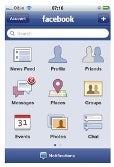
Consumers using standard mobile phones can now download the social network's Facebook for Every Phone app. According to the company, users will be able to see their News Feed, check for messages in their Inbox, and view photos. Users can also upload images and find friends from their contacts list.

Much of Facebook's growth can be attributed to mobile devices. The social network's co-founder and CEO, Mark Zuckerberg, said last week that the site now has 750 million active users. A whopping 250 million active users access the social network from their mobile platforms, according to Facebook's site, and those folks have proven to be "twice as active on Facebook than non-mobile users."

Although Facebook already offers smartphone applications for iOS and Android, among other platforms, its decision to embrace feature phones is a smart one, considering the sheer number of people who still aren't using a smartphone. According to a study released earlier this week by Pew Research Center, 83 percent of U.S. adults have a mobile phone, but only 42 percent of them have a smartphone.

Free Data for 90 days:
Just 35 percent of all American adults have a smartphone. For Facebook, a key limitation of feature phones is that most consumers don't typically pay for data on those platforms. And the social network's app requires data to function. Facebook acknowledged that reality in its blog post announcing the new app, and said that it has partnered with a host of carriers around the world to offer users free data for 90 days to address that problem. Facebook has partnered with Aircel, Airtel, Idea and Reliance to provide free data for 90 days.

Facebook for Every Phone appCarriers offering free data access:
•   Aircel (India)
•   Airtel (India)
•   Banglalink (Bangladesh)
•   Beeline (Russia)
•   Celcom (Malaysia)
•   Etisalat (Egypt, Nigeria)
•   Globe (Philippines)
•   Idea (India)
•   O2 Telefonica (Germany)
•   Reliance (India)
•   Smart (Philippines)
•   Smartfren (Indonesia)
•   Telkomsel (Indonesia)
•   Three (Indonesia, United Kingdom)
•   TIM (Brazil)
•   TMN (Portugal)
•   Ufone (Pakistan)
•   Vodafone (Turkey)

Surprisingly, Facebook did not include any U.S.-based carriers in its list of companies providing free data. The social network did not immediately respond to request for comment on whether or not the free-data offer is being extended to folks in the U.S. According to Facebook, its app is available on more than 2,500 mobile phones. 

People interested in using the app can surf to the company's mobile page (http://www.facebook.com/mobile/), scroll to the bottom, and click the download link. It's also available in app stores GetJar, Appia, and Mobile Weaver. One can also download facebook application directly from d.facebook.com/install.

Review: I have used it on Nokia C3 and it is working fine and loading speed is good. Only camera function to upload photos directly is not supported on Nokia C3.

Tuesday, July 5, 2011

What 'Awesome' Thing will Facebook Launch?

facebook zuckerbergLast week, Facebook CEO Mark Zuckerberg said that his company will be "launching something awesome" on Wednesday. Little additional information is available about what it could be, although we can take some educated guesses based on Facebook's priorities and plans.

Here's what we think we might hear from the social networking site when it announces its latest creation at 10 a.m. Pacific Time tomorrow at its Palo Alto, California headquarters.

Project Spartan

facebook zuckerbergDeveloping for several different platforms at once is definitely an unenviable task for Facebook's coders. Thus the company has embarked on a new path dubbed "Project Spartan". Essentially it's a development platform that is based in HTML5, which is supported across several platforms.
Using HTML5 in Facebook's mobile apps would be smart. The company would not need to depend on Apple to approve its app for inclusion in the App Store over seemingly minor updates to functionality within its app, and could unify the experience from platform to platform.
But -- not so fast! MG Siegler at TechCrunch reports that Project Spartan won't be ready until the middle of this month at the earliest. It also seems likely that these features would be rolled out gradually and not need a press conference to unveil them.

New iPad App

facebook zuckerberg ipadAnother possibility is that Facebook would finally commit to the iPad platform and release a native app for it.
For whatever reason, the social networking site has left the task of iPad development to third parties -- much to the chagrin of some users. Obviously, the Facebook iPad experience leaves a little to be desired, and social networking by Apple's tablet is certainly not as good as if Facebook's coders did it themselves.
Zuckerberg is said to be working closely with developers on crafting the user experience of this said app, so a press conference with him playing a major role makes sense.
But then again, developers may want to wait for the completion of Project Spartan before releasing the app -- no reason to recode it for any necessary changes.

New Photo-Sharing App

TechCrunch's revelation of a photo-sharing app certainly had the tech world abuzz several weeks back. The company is apparently going after Instagram, Path, and Color all at once with its offering, while aiming to make its photo experience that much more social.
Conflicting information seems to now exist as to whether Facebook plans to make this a standalone application or integrate it into the current Facebook application. Again, this all seems dependent on Project Spartan's progress.

Partner with Skype on Video Chat

facebook zuckerberg skypePopular speculation about what's happening on Wednesday suggests a partnership with Skype for video chat. This makes some sense; Microsoft purchased the chat service not too long ago, and Microsoft and Facebook have been pretty close over the past several years.

A partnership would be a major coup d'etat for Skype, which would immediately gain access to Facebook's 750 million-person userbase -- and it would certainly make Microsoft's $8 billion investment in the company look a little more reasonable. Some analysts have said they expect Microsoft to hook Skype up with Facebook in some form since the deal was announced in May.

Sunday, July 3, 2011

Google Plus threat to Facebook, Twitter

And thus, with Plus, Google owns us whole.

That is, of course, only one way of looking at Google's labour of over one year, when the team guys sat writing codes, eager to make as big an impact in the social media sector as in the mail, search, photo and document storage domains.

This time, they were also hoping to do one better than Orkut, which was literally steamrollered by Facebook in popularity and functionality, and certainly better than its disastrous Wave. The idea, one supposes, was to create a product that would make a mash of its prime competitors Facebook and Twitter and wipe them out. Will Google + do that?

Google + is still in its snooty, exclusive, I-will-call-you-don't-call-me phase, but let us remember that was Mark Zuckerberg's strategy initially as well. Facebook was the privy of exclusive Ivy League schools in the U.S. and the U.K. until the blitz happened. So, invitations are still scarce to come by, not all those in the Plus can extend invitations to friends who are still nonplussed. However, for sure, there are many more being added to my circles every night, nearly thrice the number than I started off with.

But when you are in, you may not notice this; it automatically signs you in on a secure (https) server, significant if you consider the recent controversies over Facebook taking liberties with users' privacy. So far, so good.

Even if you missed that, there is no way you cannot pause at the nearly spartan, neat, user interface. As yet uncluttered in comparison to FB, and only four silos (Home, Photos, Profile, Circles) to click on. Yeah, no games, and thankfully, no Farmville! On the face of it, it is simple; yet, it takes some initially to figure out the Google +. The ‘Stream' is the equivalent of FB's scroll newsfeed, and there are similar options — to share, edit, host photos and videos, and delete them. You can also ‘mute' those annoying conversations on your Stream. Phew! There is also the ‘Sparks' component, which according to Plus, “…looks for videos and articles that it thinks you'll like, so that when you're free, there's always something to watch, read and share.” Your grandpa will approve, it adds, but who is looking for Grandpa's approval rating on social media?

What is utterly out of the box for social media is the ‘Circle' concept. Literally, you can create your own social spheres, including friends, acquaintances, colleagues and contacts in different circles that are more than faintly reminiscent of school-level Set Theory. You can choose who you want to share specific information with, hiving off various groups that may be in conflict with each other: a boss versus someone to whom you are bitching about him.

A thumb tack aids you to transfer multiple persons on to the circles; and every circle you delete merrily jigs away out of the screen. Will subsets of intersecting Venn diagrams soon come to play, where diagrammatic impressions mapping friends who belong to more than one circle? It certainly will jazz Plus up. ‘Hangout' is Google's version of ‘teleportation,' a.k.a. ‘video chat' and is certainly cool thus far.

Mobile Google Plus is adapted finely for Apple's iOS and is functional on the Android platform (tried on HTC phones), but does not deign to work on the Symbian platform (tried on two of Nokia's E-series). Snooty again? Because even as the migration to Android or iOS gathers steam, there are still millions of users on Symbian, and everyone knows the link between Twitter's phenomenal growth and the facility of mobile phones.

Even if you are in, there is the fact that Plus is about a week old.

Wednesday, June 29, 2011

Google+ Social Network: Hands On First Impressions


Google's new social networking site Google+ has a few rough spots, but is, overall, a strong start to the search giant's challenge to Facebook.

Google's new social network, Google+, premiered Tuesday promising a new spin on socializing online with a slick interface and unique way of sharing content. The service launched to a limited number of users Tuesday in what Google is calling a "field trial." A few PCWorld staffers were lucky enough to be invited (it’ll roll out to everybody in the coming months), so naturally we got right to testing the new service.
In general we thought the service borrowed some good ideas from the reigning king of social networks, Facebook, but also offers some cool new approaches to sharing content and managing privacy. In short, Google+ is a solid start to an insurgent social networking platform that is sure to be enhanced rapidly over the coming months, and could soon offer a solid alternative to Facebook. Now, let's dig in.

Getting Started

Google+ has an easy set-up with almost no learning curve, especially if you're familiar with Facebook. If you’ve used any Google products before, you might be surprised at how much of that information gets automatically imported to your new Google+ account, to use in a social context. For example, I’ve uploaded pictures to Picasa without allowing others to view them. Google+ first asked me to select a profile picture from my Picasa Albums, and then gave me a choice: Either link my Google+ account with Picasa, or don’t join Google+ at all.
I decided to link. It didn’t actually change the privacy settings of my Picasa albums (it didn’t make them public to my friends or anything). But having the choice made me wonder what the implications of having my Picasa albums linked to Google+ really were.
Google+ Hands OnOne of the first things Google+ prompts you to do is select a profile picture. If you have a Picasa album, it’ll allow you to choose images from there.
Google+ Hands OnEither link Google+ to your Picasa pictures or you don’t use Google+ at all!
The next place you go after you’ve set up a Google+ account is to the “About Me” section. You can tell that Google is trying to be a little saucier than Facebook, or at least have an edgier personality.
While Facebook profiles ask you the basic questions: gender, relationship status, religion, favorite movies, TV shows, music and so forth, Google+ asks you to make an introduction, like you’re back in the first day of your high school speech class, and then asks you to list “bragging rights” like “survived high school", "have three kids", etc.
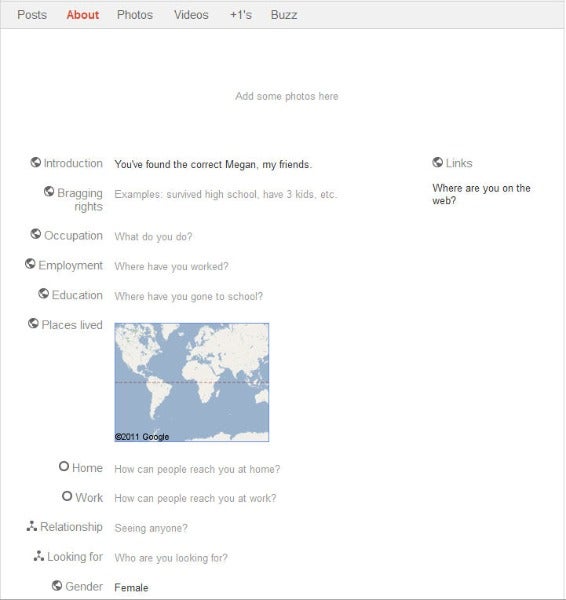
Google+ Hands OnYou can pin “places you’ve lived” on a Google map in the “About Me” section--a cool feature for globetrotters (or Army Brats).

Forming Your ‘Circles’

Google+ imports all of your information from Gmail automatically--and that means all. When you’re updating your friend circles there’s a tab towards the top of the page that says “Find and Invite”; click on it and you'll see a list of just about everyone you’ve ever sent an email to through Gmail alphabetically--even if the last time you sent them an email was four years ago. It's not surprising that Gmail remembers everyone you’ve every sent an email to--but it's a little jarring when all those names come rushing back at you at once.
Now, how to organize all those people. Google claims to have done a radical rethink of the way social networks ought to work, so that they more closely mimic the way we organize our friends in real life. After using Google+ for just a few minutes I began to appreciate the simplicity of the "circles" approach. And I really like the way Google has represented it in graphical form in Google+: that is, you actually pick up people with your mouse and drag them into this circle or that.
Nice job Google--it makes me think you’re finally getting a grip on this social thing after all.
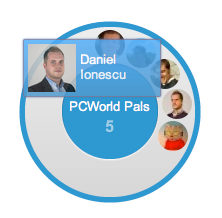
Google+ Hands OnGoogle+ users can drag and drop their friends into the appropriate social circles. Here I'm dragging my colleague Daniel Ionescu into my "PCWorld Pals" circle.
However, because this drag-and-drop function is behind the Circles tab, I began trying to add friends by searching for them from the Google+ homepage. When I would visit a potential friend's page and add them to one of my circles, it wasn't immediately apparent to them that we were now linked. I hope Google moves the Circles function to the front, making the process of forming connections a bit more user friendly.

Sharing Content

Google+ answers the call of many a privacy activists to provide the functionality needed to set the privacy level on each piece of content shared. For instance, when I share an article or upload a camera image, Google+ gives me choices of which friend circles I’d like to share that content with. A picture from my phone might be perfectly fine for my Close Friends circle but very wrong for my Colleagues circle, for instance.
Google+ Hands OnFor every piece of content you share on Google+ you're asked which circles or individuals should be able to see it.Still, I’m not sure that Google has given us the deep privacy controls that we might need. I’m not seeing the tool that let’s me carefully fine tune my sharing rules with a particular circle. I created a new circle for a new set of friends, but did not see where I could set the privacy settings for that group. Am I supposed to rely on the stock privacy settings Google has applied to the Friends, Family and Acquaintances circles it gave me to start with?

Stream = Facebook News Feed

The “Stream” section of Google+ is analogous to Facebook’s News Feed, and it does almost nothing different except for the fact that before you post anything, you have to decide which circles see it. You can make it available to “all circles” or even available to “extended circles” where you basically email what you post to people who aren’t on Google+.
Google+ Hands OnThe Stream function in Google+ is very similar to the News Feed in Facebook. Controls at the side of the page allow you to choose which of your circles of friends can contribute items to your stream.
Choosing who sees what in your stream might do one of two things when everyone starts using this: either your news feed will finally have information that pertains only to what you’re interested in, without the blast of “everyone from knitting club message me!” updates; or your stream will become immensely boring, without any of the emotional impulse-statuses that make Facebook a salient place for social information. Would you post a dramatic break-up status to the world if you could just send it to your “Circle of Close Friends”? Probably not.
Of course, people who see your stream updates can comment on them, and Google’s version of Facebook’s “Like” is to “+1” it (Google premiered the "+1" feature earlier this year, which basically allows you to say "hey I think this website is cool" by clicking a "+1" button that appears next to items on your search page). Just as Facebook created new words for using its site (“I’ll facebook you when I get back to the city”) maybe later this year we’ll be telling each other “I pluss-one’d your video last night”.

Hangouts

One interesting feature that could really put Google+ ahead of Facebook is its “Hangouts” feature. Google+ Hangouts are a kind of mashup of video chatting through gmail, and the old “chat rooms” of the days when AIM was our only chat option.
First, you click on the “Start a hangout” button, and it takes you to a separate webpage and enables your webcam and mic (while it's loading it even gives you a “fix your hair and make sure your mic works!” message, so you’re not taken by surprise). Then, you invite circles of friends, or individual friends to the Hangout room for the video chat session. You can create Hangouts of up to 10 people.
Google puts the image of the person who is talking at the center of the screen. If multiple people are talking at once it moves the one who is talking loudest to the center (that’s a good lesson for you kids out there).

Sparks

One of the first ways Google will try to win users from Facebook is by leveraging the assets it already has. Search is, of course, Google's crown jewel. Where at Facebook you have to go wander around the web finding sharable content, Google+ brings the content to you.
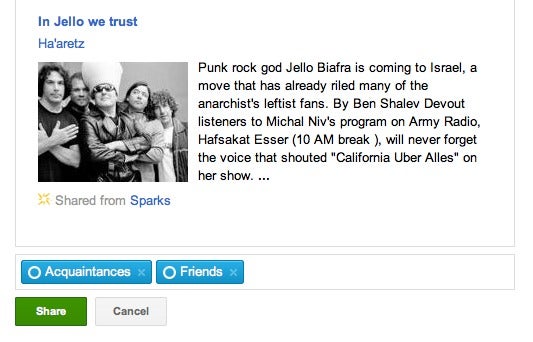
In the Spark section I entered one of my interests--punk rock--and the Google search algorithm brought back a bunch of mainstream media articles, YouTube and Vimeo video, and blog posts. After selecting an article about my friend Jello Biafra, I chose which of my 'circles' I wanted to share the content with.The feature asks you to choose from a list of possible interests (biking, sailing, sewing, etc.), or to enter your own specific interest. Google then goes out and gathers relevant content from all over the Web. I found the content suggested by Sparks to be almost completely on-topic, and I even found some content that I could actually see myself sharing with friends. Importantly, you can choose which friend circles or single friends you want to share the content with. The posts show up in those friends’ news feeds, or as Google calls them Streams.

Mobile Apps
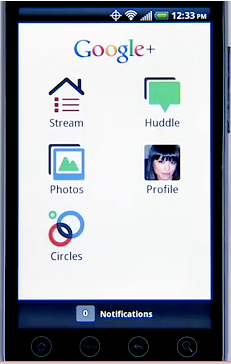
Google+ Hands OnThe Google+ Android App lets you see your news stream, upload photos, manage your social circles, edit your own profile and start group chats using Huddle. Image: GoogleGoogle also debuted a couple of new mobile apps today, both of which work directly with your Google+ account online. While some other users I talked to had some trouble forming the handshake between the apps and the Google+ service, I had no problem.
Firstly, the main Google+ Android app (available for free from the Android Market) does a nice job of bringing the core parts of Google+ to a mobile device. The app sports a simple home screen with icons for the Stream, Huddle, Photos, Profile and Circles sections of Google+ (see image). You can easily post notes and content, and comment on others’ shared materials, from the app's Stream screen. It also asks you if you want to attach your location to the posts you make.
The Photos section shows you images shared by your friends, uploaded from your phone, stored in your albums, and photos of you shot by others and shared on Google+. A little camera icon in the top right corner brings you your camera app and lets you quickly post a picture to your “From Your Phone” album at Google+. I was a bit disappointed here, because Google made it sound as if photos taken from within the app were automatically sent to your Google+ album; but in truth you have push a "Done" button then go to another screen where you're asked if you want to attach a note or your geographic location to the photo. You have to go back into your album to designate which friend circles can see your photos.
When you are reviewing your photos you can “tag” the people in them similar to the way you do in Facebook. You draw a little square around a person's face, then type in their name in the box below (or choose one of the names Google+ guesses) You can tag people who are Google+ users or just email contacts.
Google attaches this note: “Adding this tag will notify the person you have tagged. They will be able to view the photo and the related album.” This is an important difference from Facebook, which does not make an effort to warn people the they’ve been tagged (possibly in an unflattering or compromising photo) and give them an immediate chance to remove the tag.
The other app, Huddle, is already included in the main Google+ app. So I’m not sure why you’d download Huddles unless you wanted only the group chatting function on your mobile device, and no access to any other parts of Google+. The Huddle function works great, however. I was easily able to initiate a group chat with come Google+ friends. And while there was a little bit of cross talk and out-of-order posting, overall the app worked well.

Privacy Approach

Google makes it very clear that the information you contribute to the social graph underneath Google+ will be used to help refine search results and to help target web ads more accurately. While Google+ seems to put a lot of emphasis on giving users control over the way they share information with different circles of friends, it’s yet to be seen if Google will be more sensitive to the privacy of users when it determines which personal data is public--that is, available for use (in aggregate or otherwise) by Google and its advertisers--and which remains private.

Battle Royal Starts Now

Google wants “Google+” to rival its number one arch nemesis--Facebook, and by the looks of things the search giant may have a fighting chance. How will Google get people to move their online social lives away from Facebook and over to Google+? Google has already amassed a large body of user data search, Gmail, Picasa, Google Videos and YouTube, etc., but it needs the highly personal data that Facebook has been so successful at collecting. Google is said to have identified its social networking initiative as the company's central goal, and has the deep pockets to quickly build Google+ into a the kind of full-blown social networking platform that can challenge Facebook.
Perhaps most importantly, expect Google to build Google+ features into the majority of its products from search to mail to video to documents. With all those great (free) services and now a tightly-integrated social networking platform under one roof, who needs Facebook? Had Google launched this strategy three years ago that may have been a good question. But the burning question now is whether or not Google is too late to the "social Web" to ever catch up.

Tuesday, June 28, 2011

Google+ takes on Facebook

The Google Plus social network

The Google+ social network is intended to rival Facebook and Twitter

Search giant Google has begun its most serious challenge to social network Facebook with the launch of Google+

Google has launched a range of new products that introduce social elements and will see it take on Facebook.

The company’s new plan is built around four separate features called Circles, Sparks, Hangout and Huddle. Google is keen to stress that the new products do not form a new, single social network that rivals Facebook, but it is the search giant’s most serious attempt to incorporate social elements into its products to date.

Writing on the Google blog, senior vice president of engineering Vic Goduntra said that “Today, the connections between people increasingly happen online. Yet the subtlety and substance of real-world interactions are lost in the rigidness of our online tools. In this basic, human way, online sharing is awkward. Even broken. And we aim to fix it.”

Initially, Google is conducting a ‘field trial’, inviting select journalists, bloggers and other organisations, and it has not said when the products will launch more widely.

Circles is the closest product to Facebook; it allows users to drag in contacts to individual groups. The aim is to allow people to share different things with different groups of people more easily. Google users will be able to add their contacts, or import them from Yahoo or Microsoft. Facebook does not permit the export of contact information to Google.

Sparks lets users share content from around the web, and suggests more content. The company calls it a ‘sharing engine’, like a search engine. Goduntra writes “Thanks to Google’s web expertise, Sparks delivers a feed of highly contagious content from across the Internet. On any topic you want, in over 40 languages. Simply add your interests, and you’ll always have something to watch, read and share”.

Hangout encourages users to share content within groups, being able to watch a YouTube video together, at the same time, despite not being in the same room. Goduntra likened it to a shared space, such as a pub, or a chance conversation with a neighbour.

Huddle is a group messaging application, that combines allows messages to be sent to large numbers of people, and is aimed at groups trying to, for instance, organise a night out.

The new services can be used via a new toolbar that Google is rolling out, aimed at encouraging people to share their status as they would via Facebook. Mobile elements also work with Android phones and Apple’s iPhone. The company has also introduced a new feature that immediately uploads photos and videos taken with Android devices. If users wish, any update can also be tagged with a location.

Initial reaction online to Google+ was either mixed or positive, largely because users have had little opportunity to try out the new services. Search Engine Land wrote that “As for a wider release, and possible success, it’s anyone’s guess. If you’re happy using Facebook, there seems relatively little to make you want to switch over to Google Plus, at the moment. Perhaps with further Google +1 integration, that might change. Perhaps if there are people who want a Facebook alternative, Google’s now got a core to build on for them.”

Technology blog TechCrunch said that “As it is unveiled to the world, Google+ sounds and looks great. But we’ve seen that before from Google. Now comes the hard part.”

Tuesday, June 21, 2011

Infosys, Tata beat Google, Facebook, Nokia to emerge as top brands in India

Infosys
IT giant Infosys and salt-to-software conglomerate Tata have emerged as the top 2 brands in India, beating global majors like Google, Nokia and Facebook, in a new index.

According to TLG's index of emerging market 'Thought Leaders', seven out of the top ten brands in India were indigenous firms.

TLG, in partnership with international research consultancy firm GlobeScan, launched the index wherein government ministers, directors of blue chip companies and newspaper editors were asked to identify corporate brands with the power to change the attitudes and behaviour of consumers, employees or politicians -- defined as " Thought Leaders".

The list of top 20 firms was peppered with Indian brands including Larsen & Toubro (5th), State Bank of India (7th), Life Insurance Corporation of India (12th), Bharti Airtel (13th), Oil and Natural Gas Corporation (14th), Aditya Birla Group (15th), The Oberoi Group (16th), HDFC Bank (17th), Dr Reddy's Laboratories (18th) and Ranbaxy Laboratories (19th).

"... Absence of many 'western' major brands from the top 20 may concern CEOs who are trying to crack the BRICs. They need to refocus their energies on telling their leadership story," TLG founder Malcolm Gooderham said.

The top 10 features two joint ventures between local and overseas companies. The JVs are Maruti-Suzuki (4th) and Hindustan Unilever (9th).

Commenting on the findings, GlobeScan Research director Oliver Martin said, "As the public's faith in corporate leadership is declining in India, companies must excel in business innovation and progressive CSR to retain a Thought Leadership position."

The top-ranked foreign firm is Google, which enters the index at number three, followed by Nokia at sixth rank and Facebook at eighth position.

"Western firms that succeed (Google, Nokia and Facebook) are those that adapt their models to local conditions, or ones that form JVs with locals in the driving seat ( Suzuki, Unilever)," the report said.

Google, through its YouTube platform, streams live Indian Premier League cricket matches, while Facebook offers mobile access for a special rate of 1 rupee a day.

Interestingly, Apple, which leads the pack in Britain and America, failed to corner a place for itself in the top 20 list in India. Apple's failure to adapt its business model to local tastes and budgets was vastly responsible for its inability to crack India.

"Indian consumers can buy a new Tata Nano car for the same price as three Apple iPhones," the report said.

Sunday, June 19, 2011

Facebook applications leaked users information

According to Web security firm Symantec nearly 100,000 Facebook applications accidentally leaked access to users' Facebook accounts for several years.

Facebook applications leaked users information


Facebook applications are Web applications that work on the Facebook platform. Facebook says users install 20 million applications on its platform every day.

Third parties, mainly advertisers, had access to users' profiles, photos, chat and other personal information, according to a post Wednesday on Symantec's blog.

Facebook acknowledges the issue and says it's been addressed. But the social-networking giant also says that Symantec's report has some "inaccuracies" and that user information was never shared with unauthorized third parties.

Symantec's report said that over the years, hundreds of thousands of apps may have gotten "access tokens," which the company described as sort of a spare key to people's accounts.

"Needless to say, the repercussions of this access token leakage are seen far and wide," staffer Nishant Dosti wrote on the blog for the company, which sells the popular Norton anti-virus and security tools.

There's no good way to estimate exactly how many access tokens were leaked, Symantec said.

Luckily, Symantec says that most app developers probably didn't realize they had this access. The company says Facebook "has taken corrective action to help eliminate this issue" after the problem was discovered last month and brought to Facebook's attention.

Facebook says most access tokens expire in two hours, meaning they'd be useless to malicious third parties after that time.

A Facebook spokesperson told that the site worked with Symantec to address the problem. But he said a "thorough investigation" didn't show any information got into the hands of unauthorized parties.

"In addition, this report ignores the contractual obligations of advertisers and developers which prohibit them from obtaining or sharing user information in a way that violates our policies," he said.

On Tuesday, Facebook announced on its developer blog that it has been "working with Symantec to identify issues in our authentication flow to ensure that they are more secure."

That post announced an update that will require all Facebook websites and applications to switch to a new, more secure system for developers.

"We believe these changes create better and more secure experiences for users of your app," Facebook's Naitik Shah wrote in the post.

Facebook currently uses a more secure authentication system for applications, but has been still supporting the older, less secure version, Symantec said. The site hasn't found evidence that any leaked information has been used in a way that violates Facebook policies.

Facebook users can void any unauthorized access an app may have by changing their passwords.

Developers whose apps use Facebook's old system will have to transition to a new, more secure development system between now and October 1, according to the blog post. The new system gives users installing an app a detailed list of the access that app will have to their personal data.

Saturday, June 18, 2011

How to prevent your Facebook Account from getting hacked?

The popularity of the Facebook is getting more and more around the world day by day. But there are some security risks and issues with the site that can put its users serious risk if they aren’t careful. The number of Facebook account hacking have been increased during the past days. Face book has unique features that make this more danger even likely.  For example, it’s very common to post personal information which can be used to steal the user’s identity.

Be careful using any application that asks to access the profile. It’s very important to safeguard your account and protect personal information from exposure, because when the hacker exposes any information he or she will expose your friend’s personal information too. So even if you don’t have any sensitive information on your profile your fiend might.

Preventive Measures

People say always prevention is better than cure. It is very easy to prevent your account from hackers than to recover after the account is hacked. Here I’m going to highlight few security practices that can prevent your face book account as well as any account from hackers.

Using Internet Explorer

There are some security loopholes with Internet Explorer. I recommend using Firefox instead of using Internet Explorer. One of the better feature with Firefox is the entire ass-on are very vital. They are:

Adblock Plus – can’t see any ads

No Script – prevent from website to run Javascript unless you permit it.

Avoid Clicking on Links

Avoid click on a link contained in any email message and also never type the URL directly into the address bar of the browser. When you get any email with a link don’t click on it. Just copy and past the link on Google and search. You can see at the very top of the search page the page you expected. You will also find the comments about phishing, maleware, etc.

Consider a Strong Password

The password you select at least should have 6-8 characters and should include letters and digits which increase the strength of the password. Don’t use same password for more than one site and make sure your Facebook password is completely different from others.

Always log out when you are done

Keep in mind always log out when you’re done. In some websites there are cookies which enable users to remember the password, so they don’t have to log in very time. But this is convenient and safe for home desktops.

Chang e the Password as often as you can

If you change your pass word so often, it makes harder to remember the password. The point is when ever any one figure out password and tries to steal your account by that time you have changed the password.

Use Anti-virus and anti-spyware software

Always scan you computer system for viruses and malwares and make sure that you keep updated your anti virus software with current updates.

Friday, June 17, 2011

Sony Ericsson unveils phones on Facebook

Sony Ericsson

Sony Ericsson Text Pro and Mix Walkman

It seems the social networking site Facebook is picking up as a new launchpad. Cellphone giant Sony Ericsson took it to Facebook to unveil two new phones -- the Text Pro and Mix Walkman.

Geared towards music lovers and social networking fans, both the handsets run Sony Ericsson operating system and reportedly have a user interface similar to the Xperia range.

Sporting a 3-inch touchscreen with a resolution of 240 x 400 pixels, Mix Walkman comes with Zappin feature which will let users preview songs before listening.

Featuring a 3.15 megapixel camera, the phone supports GPRS/EDGE, Wi-Fi, Bluetooth 2.1 with A2DP and Stereo FM radio with RDS. The phone's memory can be expanded up to 32GB.

Sony Ericsson Text Pro features a slide-out QWERTY keypad and comes preloaded with Friends application that lets users scan through the Facebook and Twitter updates.

Like Mix Walkman, Text Pro too comes with 3.2 megapixel camera and sports a 3-inch touchscreen display.

Both the phones are expected to be available from the third quarter of this year.

Thursday, June 16, 2011

Why Facebook Is Losing U.S. Users

Facebook decline

News hit the other day that Facebook may have lost about six million users in the U.S. in one month, according to Inside Facebook, a site that analyzes the social network for developers and marketers. Facebook has close to 700 million users worldwide, so a loss of six million doesn't sound like much, especially in light of data that suggests the service has been pushing aside regional social sites to conquer large swaths of the developing world, and actually posted a net increase in overall users over the same period.

But a six million user loss is a little more painful when compared to the U.S. user base, which reports say stands around 150 million—or roughly half the population of the country. It's not crippling, but a four percent reduction isn't negligible either. At the same time, the same data source suggests the service is experiencing similar losses throughout the Western world in places like Canada, the U.K., and Norway. Could American audiences finally be turning on the social network?

When asked about the report, a Facebook spokesman told PCMag that, "From time to time, we see stories about Facebook losing users in some regions. Some of these reports use data extracted from our advertising tool, which provides broad estimates on the reach of Facebook ads and isn't designed to be a source for tracking the overall growth of Facebook. We are very pleased with our growth."

Facebook itself may not put a lot of stock in the numbers, but it tellingly didn't offer any of its own. Absent official statistics, industry observers tend to believe the report.

"I think the data to be correct." says Lou Kerner, a social media analyst with Wedbush Securities, a Los Angeles-based investment bank. "As Facebook starts to get near 50 percent penetration in a lot of these countries, the growth starts to slow. A little bit of fatigue sets in. Older people who sign up don't get as much value as younger people do, so they tend not to stick around. They come and they go."

So assuming the data is correct, why is Facebook losing U.S. customers? There are a few possible explanations:

1. Seasonal Changes

One of the simplest explanations for the change is that it's just a normal blip in Facebook's seasonal cycle. Every spring, many college students graduate, and while their Facebook profiles don't get deleted, their Internet habits can change rapidly, especially when suddenly faced with the prospect of selling themselves to potential employers. Inside Facebook notes that "short-term factors" like this may be obscuring overall trends.

"May starts the seasonally slow period for social networks," says Kerner. "Kids have finals and leave school, so they get out of their social networking routine."

2. The Privacy Envelope Has Been Pushed Too Far

This is the favorite go-to theory for pundits, since everybody likes to talk about privacy when Facebook makes headlines. It makes sense on paper: Facebook makes some change or introduces a service that appears to make the site less private or secure, everybody makes a big deal about it, and Facebook (typically) goes ahead and does it anyway. Then everyone starts to theorize when users will begin leaving en masse in defiance.

The theory overlooks the inconvenient fact that through all of Facebook's privacy shenanigans (and there have been many), its user base has grown massively, and the most recent hullabaloo over the site's new facial-recognition abilities is small potatoes compared to controversies of the past. To suggest that the Facebook finally hit the last straw on privacy over the last month assumes users just started caring about the issue.

"I don't think this is a Facebook problem as much as it's a privacy on the Internet problem," says Kerner. "I think more than driving people away, it's stopping people from coming."

3. Facebook's Time Has Come

It's probably inevitable: Somehow, someday, Facebook will start to decline, just like its predecessors MySpace and Friendster. Its users will slowly lose interest, moving on to other networks and platforms (possibly Twitter, or whatever emerges from Apple's iCloud). It seems impossible given Facebook's colossal user base and rapid growth, but it would be far from the first complacent empire that fell.

The problem with the theory is that it completely ignores another, more important statistic: user engagement. According to Alexa, people visiting Facebook are actually visiting 40 percent more pages per visit than they were just three months ago. That's not the picture of a disinterested populace ready to pack its bags for the 140-character wilds of Twitter.

"Facebook's page views per user have continued to grow very rapidly on a global basis," says Kerner. "Before you see an decline in users, you see a decline in engagement. Unique users don't become highly engaged and drop off—they use it less and less and then drop off."

So Facebook's users are spending more time on the site than ever, though the overall number of users may be declining slightly, at least in North America and few other places. Still, when your market penetration is as deep as Facebook's, it's going to be difficult to avoid the occasional downward arrow.

Kerner admits, "Facebook isn't for everybody." That's certainly true, though it's just as certain that everybody has at least heard of it. Even if the company launched an all-out marketing campaign tomorrow to try and recruit new users to make up for those who left, I suspect it would have little effect. The people who want to be on Facebook are there, and those who aren't probably never will be (or never should have been).

As for the six million users who left in the last month, they're probably similarly divided: some are just taking a break and will be back, while the others probably weren't the sharing type in the first place. That's not something the social network would like, but if there were a "Live With It" button, it's an easy click.