Thursday, November 24, 2011
Saturday, November 19, 2011
A View of Trade Fair (IITF) 2011
A painting worth of 5crore in Rajasthan Pavilion is the most attracting.
Let us see whats in there. This years major attraction is Thailand Pavilion which is attracting girls.
Whats new in IITF 2011
Focus state: Bihar and Orissa
Theme: “Indian Handicraftsthe Magic of Gifted Hands”
Partner State: Jharkhand and West Bengal
 |
| Thailand Pavilion. (specially for girls...) Special Attraction: ornaments, house decorations, |

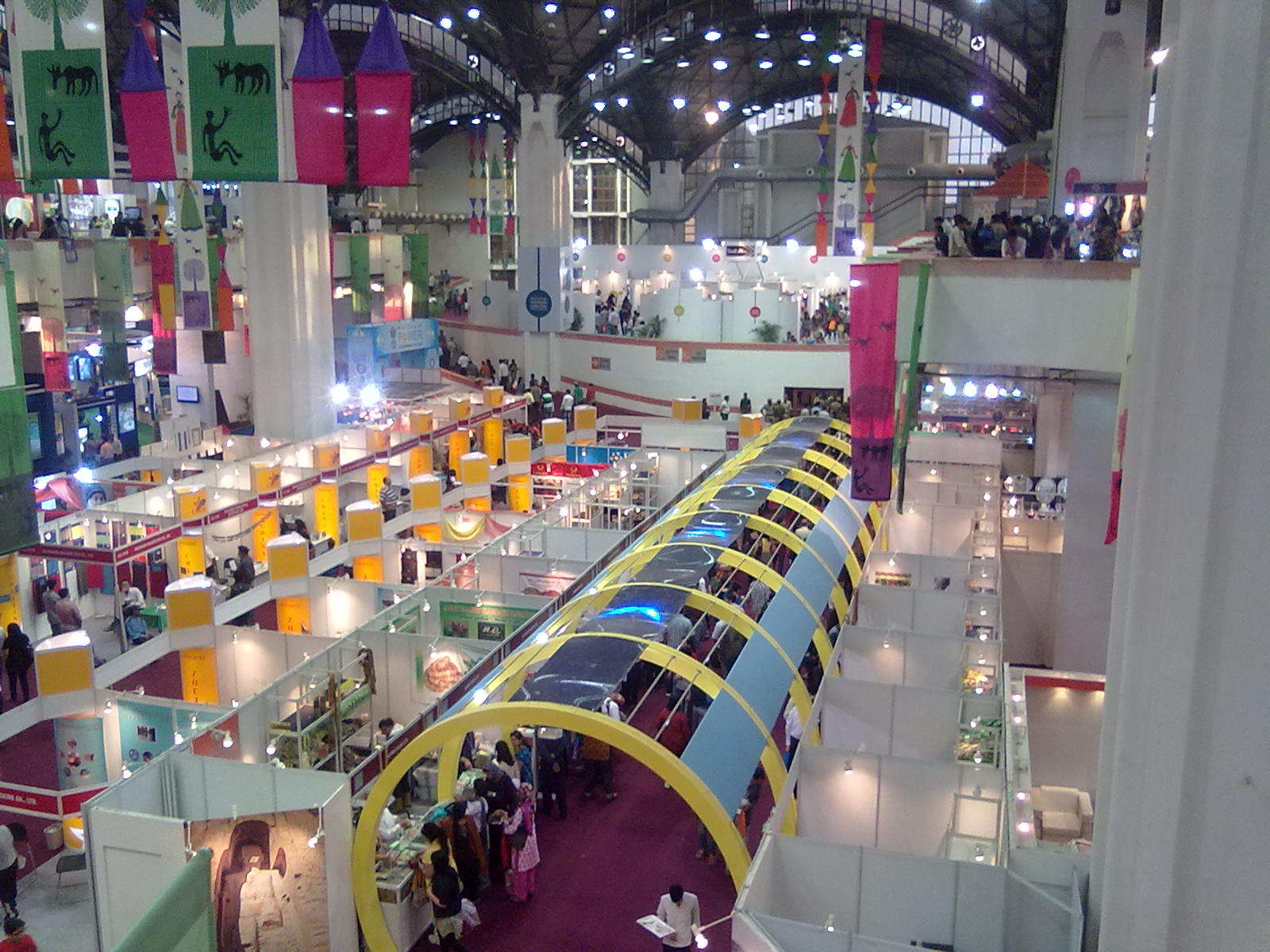 |
| Overview of International Pavilion having Afghanistan, Czech Republic. Special Attraction: Afghani spices, dry fruits, perfumes. |


 |
| A dance performance from Ministry of Steel. |

 |
| 5 Crore worth Painting. Major attraction in Rajasthan Pavilion. This painting took 4 years to complete. Has lakhs of Taj Mahal, kings, horses, elephants etc in the painting. |
 |
| Delhi Pavilion. Decoratives range from 50 to 100. |

 |
| Andhra Pradesh bamboo hat. |
 |
| Andhra Pradesh traditional dance performance. |
 |
| Andhra Pradesh pavilion |
 |
| Gandhiji in Gujarat Pavilion. |
 |
| Goa pavilion |


 |
| Bihar Pavilion |


 |
| West Bengal Pavilion |
Friday, June 10, 2011
‘Big Apple’ pays homage to M.F. Husain

After Dubai, New York City became a second home for celebrated Indian painter M.F. Husain, who was described by the Indian Americans here as a genius and master of colours who took Indian contemporary art to new places.
The artist, who died on Thursday, was often seen at Tamarind Art Gallery in Manhattan where he held his painting exhibitions due to his close rapport with the founder of the gallery and businessman Kent Charugundla.
“Husain was first and foremost a great painter, the ’Picasso of India’, a genius who took Indian contemporary art to new places, and spearheaded the progressive art movement of India,” Charugundla said.
Forbes called him “Picasso of India” in Dec 2006.
The passing of Husain is a great loss to the world of contemporary and modern art, said Charugundla, a native of Andhra Pradesh, on his way to catch a flight to London to have a last glimpse of the face who he held in high esteem.
“It is also a great loss to me personally, my wife Marguerite and our children.
“Every time I travelled with him either to Kolkata or to Mumbai, the stories he shared with me were memorable,” he recalled.
“He took me to a location to show me a painting he had done some time ago, on the wall of the Cricket Club of India in Mumbai and narrated a story of 1940s, much before India became free.
“At that time he wasn’t allowed to enter the grounds because he was Indian and the grounds were only for the British. “So Husain said he watched the game from a hole in a side gate.
“He told me that as a young man he was angry that this was his land and his country and who were these invaders to tell him that he could not get in, this immensely affected his life and it pushed him to aggressively painting and expressed his anger and dissatisfaction on the evils of the society. “He was not only a great painter but a good storyteller,” he said.
Malini Shah, only Indian-American advisor on the board of Queens Museum of Art described Husain as a legendary painter.
She said Husain was a master of colour and lines and got inspired by Hindu temple art and Cubism.
His paintings could be anything but his favourite subject was woman as a giver of life and love, she said.
He respected women and will forever be India’s greatest artist of all times, she said.
Thursday, June 9, 2011
MF Husain’s life and brush with controversy

No stranger to controversy, the artist, thus, got into hot water for his artwork, created decades earlier, that featured Hindu goddess Saraswati allegedly in the nude.
Deploring him for allegedly harbouring an anti-hindu spirit in his craft, Bajrang Dal activists wrecked 23 tapestries and 28 paintings of the artist's displayed at Ahmedabad's Herwitz Gallery a month later.

"If Husain can step into Hindustan, what is wrong if we step into his house," wrote Shiv Sena supremo Bal Thackeray of the 1998 incident where right-wing acvtivists ransacked Husain's house vandalising his works once again.
Twenty-six were arrested by the police in connection to the incident.

Husain's 2004 film Meenaxi: A Tale of Three Cities, directed by his son Owais, featured a song titled Noor-un-ala-noor (light of the superior kind in Arabic)— a phrase from the Koran in praise of prophet Mohammed, reappropriated to describe the beauty of heroine played by Tabu received the ire of Muslim organisations led by the India Ulema Council. Husain, who wrote and produced the film, decided to pull the film out of theatres instead of deleting the song from the print.

In 2006, Husain ruffled feathers once again by being the artist behind nude Bharatmata — a sacrosanct figure in Indian consciousness and pre-Independence art. The painting was featured in the magazine India Today.
A non-bailable warrant was issued against him by a Haridwar court the following year. However, in 2008, the Supreme Court dropped all charges against Husain describing his Mother India as a work of art.

In 2007, Husain, still infamous for his 'nude' paintings, was to receive acclaim from the Kerala government in the form of the prestigious Raja Ravi Varma award
Sabarimala spokesperson, Rahul Easwar, one of several protesters had the Kerala high court grant an interim order to stay the granting of the award.
The petition was later disposed off.

In 2010, Husain's absence rather than presence stirred debate with him accepting Qatari citizenship.
Born 32 years before India attained Independence, myrid legal cases and threats to life had prompted the artist to seek sanctuary in Dubai. Husain died a Qatari citizen on June 9, 2011 in London, United Kingdom.


